Blog / Soft skills
ABCDE: Soft Skills for a New Era
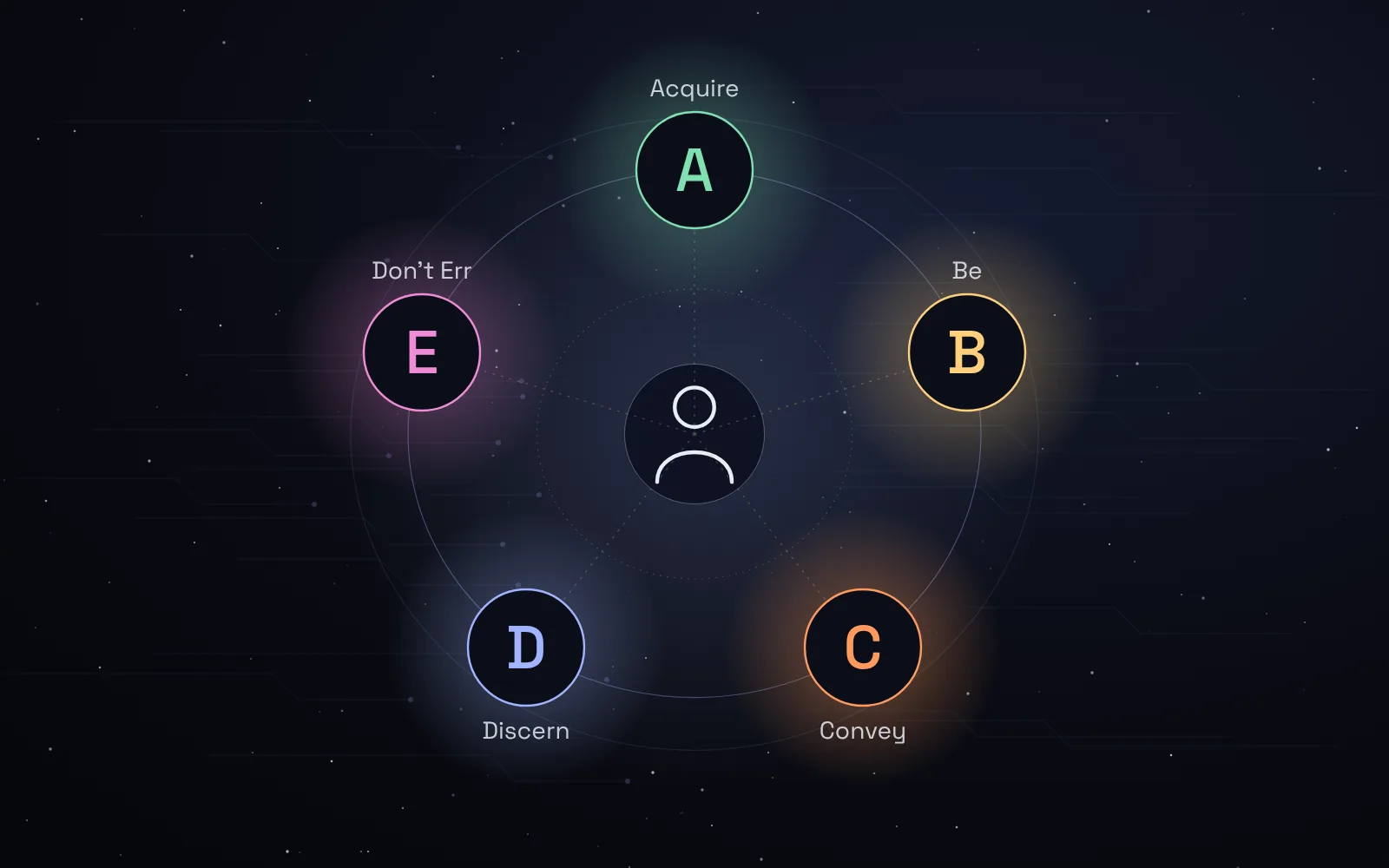
The prosperity of digital technology, now evident across human society, marks another major age of progress — one that has brought leap-like change to almost every corner of humanity with access to digital technology, especially in quality of life and in the productivity of both manual and intellectual labour across economic sectors. Yet working life in this new era differs from the past in one striking way: we must keep up and adapt to changes that leap ahead at the pace of the world. Working people can no longer rely on skills that stand still or circle within narrow limits. They must stay flexible and keep growing to fit the new paradigms and systems that organisations adopt to stay competitive — or be washed away by the tide.
Jobs in many professions are affected in two main ways. First, many new kinds of roles have emerged — roles earlier generations could not have imagined, just as we today cannot imagine the roles that will appear in the future. Second, many existing roles have already been replaced by automation and artificial intelligence, and many more will surely disappear over time, because human work leaves plenty of gaps that sufficiently advanced digital technology and machines can assist with or replace entirely, as we have seen time and again.
So if working people want to stay in the game and keep their jobs, they have to fight back by moving into the gaps that digital technology and machines cannot yet reach — gaps where organisations still need human skills and intelligence. These gaps are endless, because the problems organisations face are countless: some tied directly to professional skills, others not tied to any particular profession. If people can reskill (move to a different set of skills) or upskill (expand the skills they already have) in ways that still meet the organisation’s needs, work — and income — will not slip away.
Skills specific to a profession are commonly called hard skills. For example, the specific skill of building structures that stand firm is a civil engineer’s hard skill; the specific skill of teaching in a well-ordered sequence is a teacher’s hard skill; and the specific skill of developing software systematically is a programmer’s hard skill. Other skills, which do not depend on any profession, are commonly called soft skills.

Soft skills cover social skills, communication, attitude, personality and emotional intelligence. If hard skills are what make an organisation want to interview us, soft skills are what let us, once hired, meet the organisation’s needs sustainably and succeed in the long run. The foundational soft skills I consider most important fall into five groups, easy to remember with the mnemonic ABCDE.
AAcquire — seeking knowledge
“A is for Acquire — seeking out knowledge.” This group is not only about learning new things. It also includes unlearning old things that no longer work (perhaps because times have changed), and relearning what we already know to add perspective or update our understanding. A curious mind that questions whatever passes through our working lives lets us do all three consistently and nimbly, building learning agility that keeps pace with the world — the readiness and courage to tackle new problems, create new things, and take chances on what may become opportunities for career growth.
BBe — an attitude ready for challenge
“B is for Be — having an attitude ready for challenges and hardship,” which can knock on our office door at any moment. One technique that always helps is cognitive reframing: when facing a negative situation, look for a perspective that turns it into a learning opportunity, and handle the situation through that lens instead of confining ourselves to lamenting our bad luck. Another very useful attitude is grounded optimism — consciously looking for the positive side of a situation while also weighing the negatives and the grey areas that are a normal part of life.
CConvey — communicating effectively
“C is for Convey — delivering messages to others effectively.” One of the first skills of communication is always asking yourself what a given message is for: to negotiate, to build understanding, to create an atmosphere for exchanging information, to raise awareness, to persuade people to change their attitudes, to persuade them to change their behaviour, or to encourage. Once you are clear about the purpose, you can commit to techniques that fit the goal without being swayed by the surrounding situation. Many of these techniques are not easy; they are skills worth practising until they flow naturally.
For long-form messages such as reports or slide presentations, another important skill is choosing among different modes of delivery to suit the situation. There are four: a plain, straightforward explanation with no colour (definition); a sequential account, for example in time order, still told plainly (narrative); a colourful telling in scenes, with a conflict, a resolution and enough dynamics to make it enjoyable (story); and a comparison that explains through a parallel situation (analogy). Each has its pros and cons. An analogy, for instance, helps people grasp difficult things through simple comparisons, but a comparison only holds within limited aspects. Stretch it too far, and when the audience thinks it through and finds it untrue, the whole message loses credibility.

DDiscern — discernment and literacy
“D is for Discern — discernment and ‘literacy’,” which here does not mean reading and writing, but understanding digital technology and various fields of knowledge. Examples include digital literacy, which means not just “knowing how to use a computer” but also “understanding privacy settings” and “being able to assess the credibility of online media and messages.” Second is data literacy: being able to tell raw data from information, connect information into knowledge, and “see through” knowledge to synthesise it into wisdom. Finally, a literacy no less important than the others is algorithmic literacy — understanding that algorithms exist and the role they play in digital technology, especially in how we consume social media.
EDon’t Err — free from cognitive bias
“Finally, E is for don’t Err — not being swayed by cognitive bias.” This includes the skill of noticing whether the person sending us a message is biased, the skill of being aware of our own biases, and — most importantly — remembering the different types of cognitive bias (looking them up in a book or on Wikipedia every time may be too slow, especially in the middle of a discussion or debate). For example, the availability heuristic makes us think something happens often, or is common, when it really isn’t — simply because the news keeps mentioning it, or it always shows up on the first page of search results. Cognitive biases are tools that marketers and “social engineers” use to manipulate society and steer it in the direction they want (as in the Cambridge Analytica case that made headlines four years ago). Skills that guard against cognitive bias keep us from becoming pawns or victims of any person or organisation seeking to exploit us.
These soft skills are fundamentals worth keeping close in an era when digital technology is a double-edged sword, creating both opportunities and threats for people. They help us seize the opportunities that come our way and stay resilient against the threats, so that working people are not washed away by the tide of technological progress.
Further reading
- The term “soft skills” comes from a 1972 US military training manual, CON REG 350–100–1, titled Systems Engineering of Training.
- The idea of learn/unlearn/relearn comes from psychologist Herbert Gerjuoy, whom futurist and writer Alvin Toffler interviewed and quoted in Future Shock (first published in 1970): archive.org/details/futureshoc00toff/page/367/mode/2up
- The Cambridge Analytica exposé, which began with the British newspaper The Guardian: theguardian.com/news/series/cambridge-analytica-files